
Making sure you choose the right boiler is one of the most important decisions you can make for your home comfort and energy bills. If you get it wrong, you could be left with a system that struggles to keep your house warm on cold Scottish mornings, one that cycles on and off constantly, which wastes energy, consequently increasing your energy bills. When you get it right, your house will be warm and more energy efficient, and a system that lasts. At Thistle Boilers, we will help you find the perfect boiler for your home. Read more of our guide to find out how we will do that.
Why Boiler Size Matters
The term ‘Boiler Size’ does not refer to the dimensions; it refers to the boiler’s output, which is measured in kilowatts (kW). This is how much energy the boiler can produce per hour. An undersized boiler will struggle to meet the demand of your household and will leave rooms feeling cold and water feeling ‘lukewarm’, where as a oversize boiler will “short cycle”, firing up, reaching desire tempaerture quickly but then switching off before completing the full heating cycle, wasting fuel and putting strain on components.
Key Factors That Influence Boiler Size
Several variables affect how much heating output your home actually needs. A professional assessment will take all of these into account, but it helps to understand them yourself.
1. Property Size and Layout
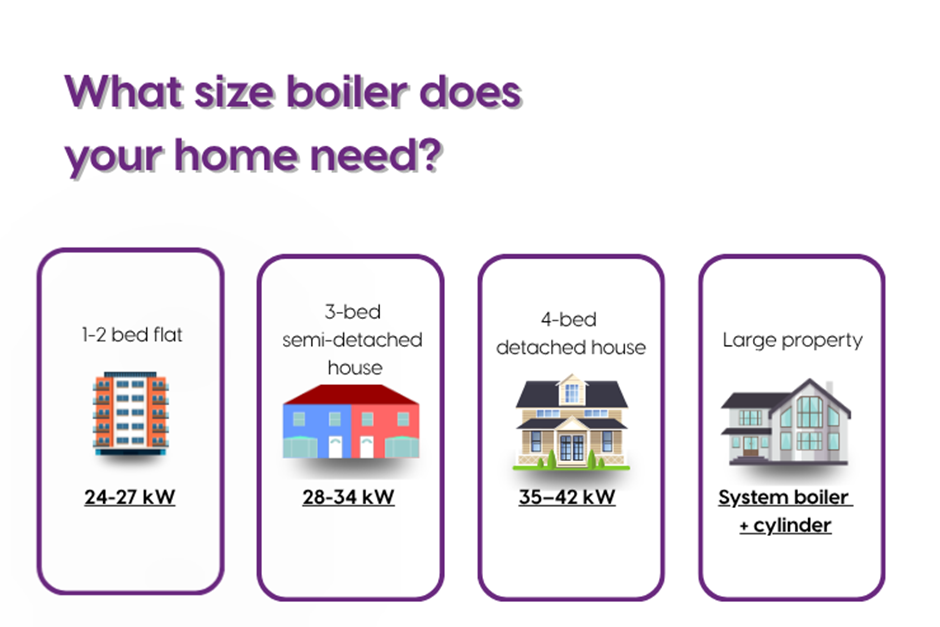
The larger your home, the more heat it needs to maintain a comfortable temperature. As a rough guide, the number of rooms you need to heat plays a direct role in determining the minimum output required. A small one-bedroom flat will have very different requirements from a four-bedroom detached house.
2. Number of Bathrooms
For combination boilers, the number of bathrooms is particularly important, as these units supply hot water on demand without a storage cylinder. A single bathroom property can generally be served by a combi rated between 24–28 kW, while homes with two bathrooms may need 28–35 kW, and properties with three or more bathrooms typically require a system or heat-only boiler with a dedicated hot water cylinder rather than a combi. This is an area where the advice of a qualified engineer, like those at Thistle Boilers, can save you from a costly mismatch.
3. Number of Radiators
Each radiator in your home represents a heat emitter that the boiler must be able to supply. As a simple rule of thumb, each standard radiator requires approximately 1.5 kW of output from the boiler. Counting your radiators gives a useful baseline before any other calculations are applied.
4. Insulation and Heat Loss
Two homes of identical size can have very different heating demands depending on how well insulated they are. Older properties with solid walls, single-glazed windows, and little loft insulation lose heat far more rapidly than modern, well-insulated homes. Heat loss calculations factor in the building’s thermal envelope, walls, roof, floor, windows, and doors, to estimate how much energy is needed to maintain a set indoor temperature.
5. Heating Demand and Usage Patterns
How and when you use your heating matters. A home that is occupied all day has different demands than one where everyone is out during working hours. Properties with consistently high hot water demand, such as large families, may also need a higher-output unit or a cylinder-based system.
Methods Used to Calculate Boiler Size
There are several approaches used to determine the right boiler output for a home. These range from quick estimations to detailed professional assessments.
The Radiator Count Method
The simplest approach involves counting the number of radiators in your home and multiplying by approximately 1.5 kW. Add around 3 kW for hot water demand if you are fitting a combination boiler. This gives a rough starting figure that can be refined by other factors.
For example, a home with 10 radiators would need around 15 kW for space heating, plus 3 kW for hot water; suggesting an 18–24 kW boiler as a starting point, before insulation and heat loss are considered.
The Room-by-Room Heat Loss Calculation
A more precise method involves calculating the heat loss for each room based on its size, number of external walls, window area, and the U-values (thermal resistance) of the building materials. The sum of all room heat losses gives the total heating load of the property. This method is far more accurate and is the kind of thorough approach that Thistle Boilers’ engineers apply when sizing a replacement boiler for a home.
The British Standard BS EN 12831 Method
This is the industry-standard methodology used by professional heating engineers across the UK. It accounts for the design outdoor temperature for your region, the desired indoor temperature, ventilation rates, and detailed fabric heat loss calculations. While complex to carry out manually, this standard underpins the software tools that qualified installers use when specifying boiler replacements or new installations. When Thistle Boilers carries out a boiler replacement, this is the level of rigour applied; not a rough guess based on what was fitted previously.
Why You Should Use a Professional
While online calculators and rule-of-thumb guides provide a useful starting point, they cannot replace a professional assessment. A qualified heating engineer will visit your property, take measurements, assess insulation levels, review your hot water usage, and carry out the calculations needed to specify the right boiler with confidence.
Oversizing and undersizing are both common errors when homeowners attempt to size a boiler without expert input. A professional will also advise on whether a combi boiler is appropriate for your home, or whether a system or conventional boiler with a hot water cylinder would better suit your needs.
For homeowners in Glasgow and the surrounding areas looking for boiler fitting in Glasgow from engineers who understand the demands of Scottish winters, working with a local specialist makes a significant difference. Thistle Boilers, serving Lanarkshire, Glasgow, and the wider Central Belt, provides expert boiler replacement and installation using leading brands including Vaillant, Worcester, and Ideal. Their team carries out proper assessments to ensure every boiler they install is sized correctly for the home it serves.
Final Thoughts
Calculating boiler size accurately is not simply a matter of looking at your property’s square footage. It involves a careful assessment of heat loss, hot water demand, radiator count, and insulation levels, all of which vary from home to home. Taking the time to get this right, with the help of a qualified engineer, will ensure your heating system runs efficiently for years to come. If you are considering a boiler replacement and want expert advice from a trusted local team, contact Thistle Boilers for a free quote. With weekend appointments available and a commitment to in-person follow-up after every installation, they make the process as straightforward as possible, from the initial assessment right through to aftercare.