
There’s nothing quite like glancing at your boiler gauge and seeing the needle sitting in the red. If your heating has gone lukewarm or your hot water isn’t hitting the mark, dropping boiler pressure is often the culprit. It’s one of the most common heating issues in UK homes, and often something you can safely check yourself first.
This guide covers what boiler pressure is, the likely reasons it keeps falling, the checks you can do at home, and when to call in the experts.
What Is Boiler Pressure and Why Does It Matter?
Boiler pressure is the balance of water and air within your sealed central heating system, keeping hot water circulating through your pipes and radiators. Most modern combi and system boilers use an expansion vessel rather than the old-fashioned header tank in the loft, which absorbs natural fluctuations in pressure as water heats and cools.
Most boilers should sit at around 1 to 1.5 bar when cold, although you should check your manufacturer’s instructions, and you’ll find a gauge on the front of your boiler with a marked “safe zone”, often shown in green.
In short: boiler pressure is the driving force behind your heating and hot water, and keeping it within the safe range is essential for your system to work properly.
What Causes Boiler Pressure to Keep Dropping?
A single drop is usually nothing to worry about, but a repeated pattern means water is escaping the system somewhere. The most common culprits are:
- A hidden leak. Leaks can appear anywhere along your pipework, radiators, or valves, and aren’t always visible as a puddle on the floor. Often it’s a slow seep at a joint that only shows up as a gradual pressure loss over days or weeks.
- Recently bled radiators. Bleeding air out of your radiators to fix cold spots naturally releases some pressure. This is expected and easily corrected by topping up.
- A faulty pressure relief valve (PRV). This safety feature releases water if pressure gets too high. If it’s worn or has failed, it can discharge water even under normal conditions, gradually draining your system.
- A failing expansion vessel. When this component loses its charge, pressure can swing erratically, rising when the heating is on and dropping once it cools.
How Do I Check My Boiler Pressure at Home?
Checking your pressure is simple and needs no tools. Look at the gauge on the front of your boiler; it should sit within the marked safe zone, typically 1 to 1.5 bar when the heating is cold. If the needle is below this, or creeping down day by day, it’s worth investigating.
Note the reading morning and evening for a couple of days. This helps you see whether it’s a one-off dip or a genuine ongoing drop, making it easier to describe if you need to call someone out.
Step-by-Step: What to Do When Boiler Pressure Keeps Dropping
If you’ve noticed your pressure falling, work through these steps before assuming the worst.
- Check for obvious leaks first. Run a dry tissue around each radiator valve, pipe joint, and the boiler casing itself. Even slight dampness will show up on the tissue. Check under floorboards or in cupboards where pipework runs, and look at the external PRV discharge pipe for dripping or staining.
- Bleed your radiators if they’re cold at the top. Trapped air is the likely cause if a radiator feels cooler towards the top than the bottom. Use a radiator key to release the air until water flows, then close the valve. This will lower your pressure slightly, so you’ll need to top up afterwards.
- Top up the pressure via the filling loop. Most systems have a filling loop, usually a braided hose with valves at either end. With the boiler off and cool, slowly open the valves until the gauge reaches the recommended level, then close them firmly. Check your manual for the exact process, as this varies between brands like Vaillant, Worcester, and Ideal.
- Keep a record. Note the date and pressure reading each time you top up. Doing this every few days or weeks is a clear sign of an underlying fault rather than a one-off issue.
- Don’t keep repeatedly topping up. Repeated top-ups can mask a genuine fault, increase the risk of corrosion, and lead to more serious problems down the line.
In short: most people can safely check for leaks, bleed radiators, and top up pressure themselves, but if the problem keeps coming back, it’s a sign to stop the DIY approach and get it looked at properly.
When Should I Call in an Expert?
If you’ve topped up correctly and the pressure holds steady, you’re likely in the clear. But a few signs mean it’s time to bring in a Gas Safe registered engineer rather than continuing to troubleshoot alone:
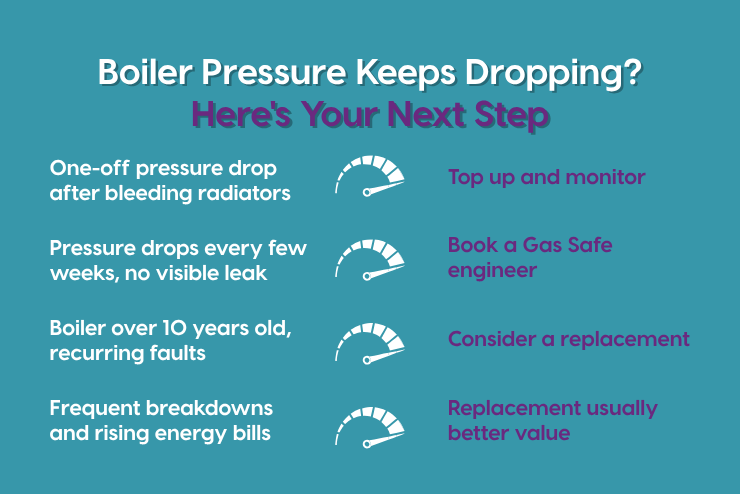
- You’re topping up the pressure more than once every few weeks.
- You can hear gurgling, banging, or unusual noises from the boiler or pipework.
- You notice damp patches, staining, or a musty smell near pipework, radiators, or the boiler itself.
- Your boiler is locking out or displaying a fault code related to low pressure.
- You can’t find any visible leak, yet the pressure continues to fall.
A qualified engineer may be able to resolve a straightforward fault, like an ageing PRV, on an otherwise sound system. But persistent pressure loss is often a symptom of a boiler reaching the end of its working life, particularly if it’s over ten years old or has needed attention more than once in the past year, in which case a new installation may be the more reliable option.
When Is It Time to Consider a Replacement?
If an engineer’s diagnosis points to a tired or unreliable system, or your boiler is old enough that parts are hard to source, replacement is usually the more sensible long-term option, especially once falling efficiency starts pushing up your energy bills.
We specialise in gas boiler services covering installation and replacement across Lanarkshire, Glasgow, and the wider Central Belt, fitting trusted brands including Vaillant, Worcester, and Ideal. For reliable boiler fitting Glasgow homeowners can count on, our team offers weekend appointments across the city and Lanarkshire, including Hamilton and Motherwell, plus personalised aftercare after every installation.
A Warm Home is a Happy Home
Dropping boiler pressure is annoying, but it’s rarely something to panic about. Work through the simple checks above, keep an eye on your gauge, and don’t ignore a pattern of repeated top-ups. If it feels like you’re fighting a losing battle with an ageing system, we’re here to help. Get a free, no-obligation quote from our team today, and let’s find the right boiler for your home.
FAQ
Is it safe to run my boiler with low pressure? Pressure below the recommended range can cause your boiler to lock out and stop providing heating and hot water. It’s not usually dangerous in itself, but it shouldn’t be ignored, as the underlying cause can worsen over time.
How often is it normal to top up boiler pressure? A healthy system should hold its pressure for months at a time. Topping up every few days or weeks points to a leak or a fault rather than normal wear.
Can cold weather cause boiler pressure to drop? Yes. Cold weather can affect pressure through increased demand on the system or pipes contracting slightly. If pressure drops significantly rather than fluctuating, it’s worth investigating further.
What if my boiler pressure keeps dropping and there’s no obvious fault? If everything checks out but the pressure keeps falling, it’s worth getting a professional opinion. Where a boiler is ageing or increasingly unreliable, we can help you find and fit a suitable replacement.
How do I know if I need a new boiler rather than a fix? If your boiler is over ten years old, has needed repeated attention, or is becoming less efficient and more expensive to run, replacement is usually the better long-term option.